
- Home
- Art Movement
- Artist
- André Poirson (4)
- Anonymous (6)
- Bouquier (3)
- Claude Revardeau (2)
- Clery Pierpont (2)
- Contemporary (5)
- Courtine (2)
- Felicia Butel (2)
- Georges Guérin (2)
- Henri Royet (2)
- Illegible (2)
- Jean-paul Ulysse (18)
- Lucien Royer (3)
- Maurice Barle (3)
- Maurice Bismuth (2)
- Renoir (3)
- René Lévy (2)
- Siarnowski (3)
- Unknown (5)
- Unsigned (4)
- Other (5447)
- Features
- Genre
- Abstrait (59)
- Académisme (57)
- Art Deco (53)
- Art Déco (50)
- Barbizon (30)
- Baroque (91)
- Classicism (101)
- Classicisme (225)
- Expressionism (223)
- Expressionnisme (160)
- Fauvism (46)
- Fauvisme (53)
- Impressionism (243)
- Impressionnisme (497)
- Impressionniste (33)
- Orientalisme (74)
- Realism (74)
- Renaissance (29)
- Romantisme (116)
- Réalisme (204)
- Other (3104)
- Theme
- Abstract (8)
- Animals (32)
- Architecture (12)
- Character (92)
- Child (6)
- Figure (7)
- Flower, Tree (18)
- Flowers (3)
- Genre Scene (57)
- History, War (8)
- Horse Portrait. (2)
- Hunting, Fishing (8)
- Landscape (480)
- Marine (5)
- Nature, Landscapes (5)
- Portrait (16)
- Religion, Mythology (28)
- Seascape, Boat (82)
- Still Life (71)
- Windmills (2)
- Other (4580)
- Type
- Acrylique (4)
- Christianisme (5)
- Composition Mixte (2)
- Folk Art Object (2)
- Gouache (3)
- Huile (3292)
- Huile Sur Bois (20)
- Huile Sur Bois. (3)
- Huile Sur Panneau (15)
- Huile Sur Toile (4)
- Icon (2)
- Mural (5)
- Oil (1709)
- Oil On Canvas (2)
- Oil On Panel (2)
- Oil On Wood (5)
- Painting (9)
- Peinture (11)
- Other (427)
Tableau Breitwieser Alsatian Painter Neo-Impressionist Hsb 46x38 8f May 1945
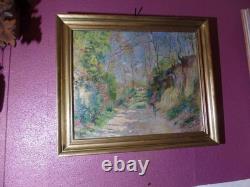
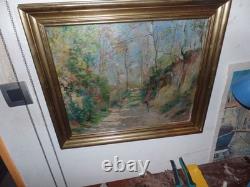
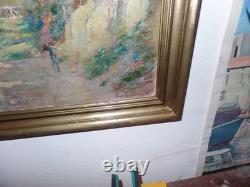
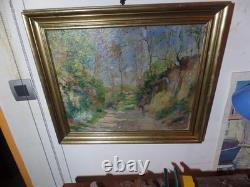
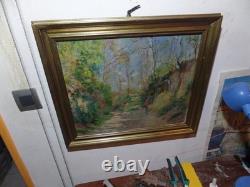
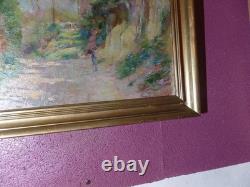
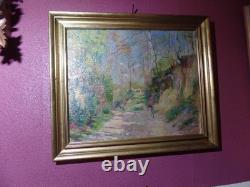
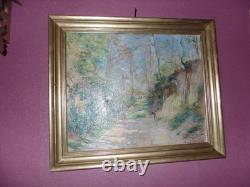
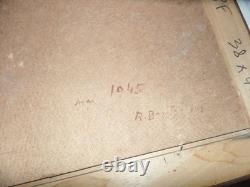

PAINTING BY ROBERT BREITWIESER, ALSATIAN NEO-IMPRESSIONIST, HSB 46X38 8F. CHEMIN CREUX DU SUNDGAU, ALSACE DU SUD, MAY 1945. SUNDGAU COMES FROM THE MEROVINGIAN, MEANING VILLAGE OF THE SOUTH. SUNG IS SOUTH AND GAU VILLAGE.................... AT THE TIME OF CLOVIS. THE SUNDGAU INCLUDES THE SOUTH OF THE TERRITORY OF BELFORT ALONG WITH THE SOUTH OF ALSACE, OTHERWISE KNOWN AS THE FOOTHILLS OF THE SWISS JURA. The work of Robert Breitwieser, considered one of the brightest in Alsatian painting of the 20th century, is part of the richness of a particular cultural heritage: that of a transitional, historical, and geographical region, a sort of adjustment variable between France and Germany, whose rivalries have significantly disrupted artistic life.
But, paradoxically, none of this turmoil is reflected in Robert Breitwieser's paintings, which offer us serene, peaceful, and soothing artwork. Born in Mulhouse in 1899, he was successively a German, French citizen, and then again German and French. In fact, Robert Breitwieser was able to benefit from this dual culture that characterizes the elite of his time. At the Academy of Fine Arts in Stuttgart in 1919, and then at the Hoffmann School of Art in Munich from 1920-1922, he became aware of the expressionism of the avant-garde movements "Die Brücke" and "Der Blaue Reiter." In Paris, where he went as early as 1919 with Schachenmann, his friend from his twenties, he undertook free studies in the workshops of La Grande Chaumière.
In 1928, he settled permanently in the capital. Oh, the exchanges, the discoveries! Cézanne, the father of cubism, Gauguin, the inspirer of the "nabis.
" The canvases of the "fauves" also caught his attention. He read "On the Spiritual in Art" by Wassily Kandinsky. At Klettenberg, in Brunstatt during the summer, or Rue d'Alésia in the 14th arrondissement of Paris for the rest of the year, his entire life was devoted to painting. The themes he finds abundantly in the family home, in the street, and in nature are the most varied.
He translates his sensitivity and impressions through his mastery of all techniques: oil, drawing, and graphic arts.