
- Home
- Art Movement
- Artist
- André Poirson (4)
- Anonymous (6)
- Bouquier (3)
- Claude Revardeau (2)
- Clery Pierpont (2)
- Contemporary (5)
- Courtine (2)
- Felicia Butel (2)
- Georges Guérin (2)
- Henri Royet (2)
- Illegible (2)
- Jean-paul Ulysse (18)
- Lucien Royer (3)
- Maurice Barle (3)
- Maurice Bismuth (2)
- Renoir (3)
- René Lévy (2)
- Siarnowski (3)
- Unknown (5)
- Unsigned (4)
- Other (5446)
- Features
- Genre
- Abstrait (59)
- Académisme (57)
- Art Deco (53)
- Art Déco (50)
- Barbizon (30)
- Baroque (91)
- Classicism (101)
- Classicisme (225)
- Expressionism (223)
- Expressionnisme (160)
- Fauvism (46)
- Fauvisme (53)
- Impressionism (243)
- Impressionnisme (497)
- Impressionniste (33)
- Orientalisme (74)
- Realism (74)
- Renaissance (29)
- Romantisme (116)
- Réalisme (204)
- Other (3103)
- Theme
- Abstract (8)
- Animals (32)
- Architecture (12)
- Character (92)
- Child (6)
- Figure (7)
- Flower, Tree (18)
- Flowers (3)
- Genre Scene (57)
- History, War (8)
- Horse Portrait. (2)
- Hunting, Fishing (8)
- Landscape (480)
- Marine (5)
- Nature, Landscapes (5)
- Portrait (16)
- Religion, Mythology (28)
- Seascape, Boat (82)
- Still Life (71)
- Windmills (2)
- Other (4579)
- Type
- Acrylique (4)
- Christianisme (5)
- Composition Mixte (2)
- Folk Art Object (2)
- Gouache (3)
- Huile (3292)
- Huile Sur Bois (20)
- Huile Sur Bois. (3)
- Huile Sur Panneau (15)
- Huile Sur Toile (4)
- Icon (2)
- Mural (5)
- Oil (1708)
- Oil On Canvas (2)
- Oil On Panel (2)
- Oil On Wood (5)
- Painting (9)
- Peinture (11)
- Other (427)
Post-Impressionist painting by Jean PIAUBERT, Oil on cardboard, French School
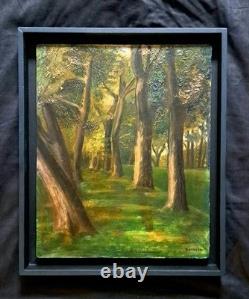
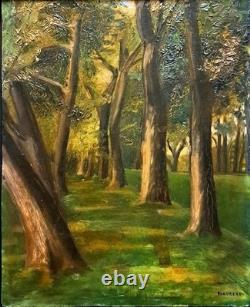

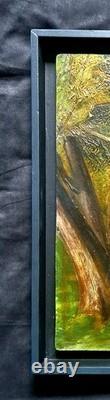
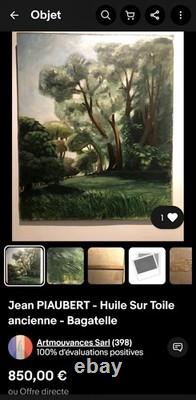
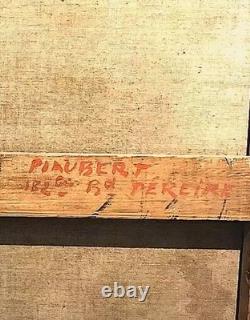


1930 in Bagatelle, between shadow and light. This work is situated in the first half of the 20th century before its abstract period that made its fame. This painter, who lived at 182 bis Boulevard Pereire in PARIS, lived near the Bois de Boulogne and painted works that came from the gardens of Bagatelle of his time (see photos n°11 and n°12 of another similar painting from the same period bearing the same signature with an original trace on the back of the work). My painting represents a verdant wooded scene of a late afternoon where light filters through the branches of the trees. This natural brightness, visible through a chiaroscuro on the trunks of the trees, sweeps across the work laterally from left to right.
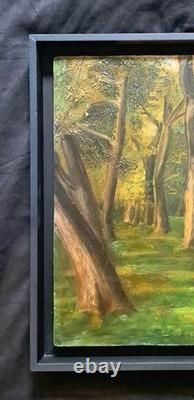
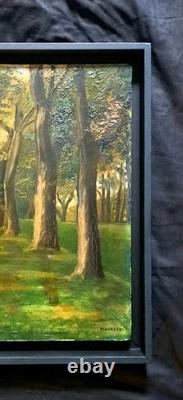
There is also a significant contrast between a thin pictorial material on the trunks of these very slender trees revealing the bark and the veins of the wood, and a very thick pictorial material in the upper part marked in the foliage at the top of the branches with impasto and textured reliefs. The overall vegetation gives an impression of a very present and still living nature. The dominant tones are deep, satin greens in a texture unique to this artist, as well as browns and ochres to create a certain ambiance, a calm yet sometimes mysterious atmosphere.
The light filtering between the trees illuminates certain areas of the ground covered with lush green grass, producing a play of stretched shadows that guides the gaze into the depth of the painting. The perspective is constructed by a succession of vertical trunks placed diagonally or straight, guiding the eye on a stroll between glade and urban forest.
PIAUBERT seems to favor an introspective atmosphere rather than meticulous realism. This construction recalls the artistic explorations of the 20th century where composition is not primarily a faithful reproduction of reality but rather a sensitive interpretation of a specific moment in the day by a painter.The contours are sometimes blurred and the textures contrasting, the soft light appears muted. This work fits into a naturalistic vein imbued with a certain lyricism.
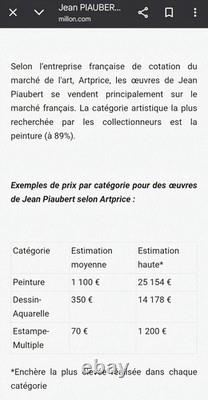
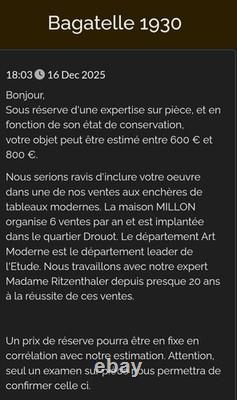
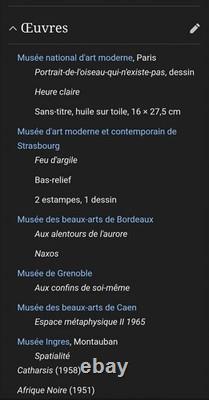
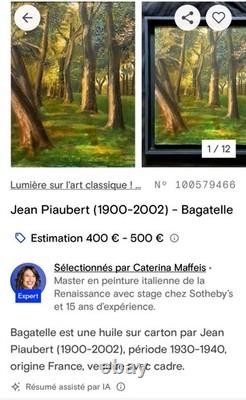
The choice of a thick paste reinforces the representation of nature. This relief gives an impression of sculpture typical of a work that also values the artist's gesture, thus giving personality to his work. Frame dimensions: 46 cm x 38 cm (6 F) Work dimensions: 40.5 cm x 33 cm. Located in the heart of the Bois de Boulogne, the construction of the gardens of Bagatelle was completed in the 18th century in a record time of 100 days. It was at the Château de la Muette, a high place of libertinism, that the great personalities of the court gathered. The name "Bagatelle" thus comes from this gallant past. Left abandoned for a large part of the 20th century, these gardens were completely rehabilitated in 1970 and no longer resemble the past pictorial representations of this place such as this painting signed by PIAUBERT, adding even more interest to the work. At the end of the slideshow, I propose to take note of the different estimates of the works of Jean PIAUBERT (photo n°8) by the auction house MILLON, an estimate from the same MILLON house (photo n°9), a non-exhaustive list of some of his works exhibited in national museums (photo n°10), and finally a recent estimate from an auctioneer at Catawiki (photo n°13).The photos were taken in high resolution (64 MB) in natural light and without any retouching. The quality of the rendered image will depend on each viewer's screen and the lighting of the room where the painting will be displayed. This authentic and rare oil on cardboard by this artist allows for the discovery of his original style, which later led him to the abstract art we know today. This work, which has existed for a century, remains in perfect condition for its age with perhaps some minor, barely visible signs of wear. It has been recently cleaned and a Winsor and Newton anti-UV satin varnish has been applied.
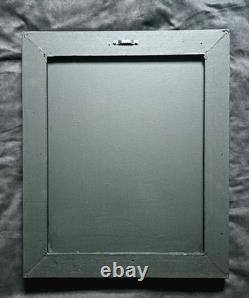
This oil on cardboard has been professionally mounted on a thick 10 mm wooden board to stiffen it and inserted into a "floater frame," very poorly translated into French as "caisse américaine." This model of wooden frame is antique and has been restored, glued, nailed, and stapled, then repainted black with a semi-transparent imitation forest green ceruse on the edge and front border.The back and inside of this frame are satin black. This frame, now very robust, is guaranteed for life.
The whole, ready to be hung, evokes a mysterious walk in nature conducive to meditation.