
- Home
- Art Movement
- Artist
- André Poirson (4)
- Anonymous (6)
- Bouquier (3)
- Claude Revardeau (2)
- Clery Pierpont (2)
- Contemporary (5)
- Courtine (2)
- Felicia Butel (2)
- Georges Guérin (2)
- Henri Royet (2)
- Illegible (2)
- Jean-paul Ulysse (18)
- Lucien Royer (3)
- Maurice Barle (3)
- Maurice Bismuth (2)
- Renoir (3)
- René Lévy (2)
- Siarnowski (3)
- Unknown (5)
- Unsigned (4)
- Other (5446)
- Features
- Genre
- Abstrait (59)
- Académisme (57)
- Art Deco (53)
- Art Déco (50)
- Barbizon (30)
- Baroque (91)
- Classicism (101)
- Classicisme (225)
- Expressionism (223)
- Expressionnisme (160)
- Fauvism (46)
- Fauvisme (53)
- Impressionism (243)
- Impressionnisme (497)
- Impressionniste (33)
- Orientalisme (74)
- Realism (74)
- Renaissance (29)
- Romantisme (116)
- Réalisme (204)
- Other (3103)
- Theme
- Abstract (8)
- Animals (32)
- Architecture (12)
- Character (92)
- Child (6)
- Figure (7)
- Flower, Tree (18)
- Flowers (3)
- Genre Scene (57)
- History, War (8)
- Horse Portrait. (2)
- Hunting, Fishing (8)
- Landscape (480)
- Marine (5)
- Nature, Landscapes (5)
- Portrait (16)
- Religion, Mythology (28)
- Seascape, Boat (82)
- Still Life (71)
- Windmills (2)
- Other (4579)
- Type
- Acrylique (4)
- Christianisme (5)
- Composition Mixte (2)
- Folk Art Object (2)
- Gouache (3)
- Huile (3292)
- Huile Sur Bois (20)
- Huile Sur Bois. (3)
- Huile Sur Panneau (15)
- Huile Sur Toile (4)
- Icon (2)
- Mural (5)
- Oil (1708)
- Oil On Canvas (2)
- Oil On Panel (2)
- Oil On Wood (5)
- Painting (9)
- Peinture (11)
- Other (427)
Oil on wood ABSTRACT COMPOSITION Signed GINO GREGORI (1906/1973)
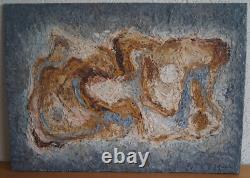
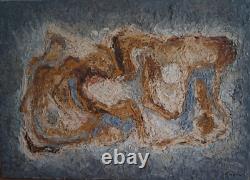
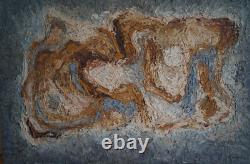
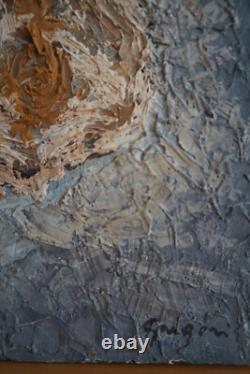
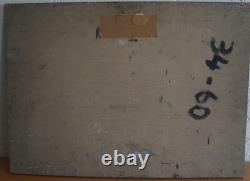
Oil on Wood Panel - Abstract Composition - Signed Bottom Right. Dimensions 38.5 x 53.5 cm - Very Good Overall Condition - Protected shipping, secure packaging - Fast shipping.
School of Paris, established his studio in Montparnasse in 1946, befriended the greats of his time: Georges Braque, Picasso, Jacques Villon, Henri Matisse, etc. He joined the Puteaux group with André Lhote, Camille Bryen... The largest Parisian galleries represent him: Galerie Bernheim, Hoche, Charpentier, and many others.
Present in numerous museums through his works. Many international exhibitions around the world showcased works by Gino GREGORI. An artist of Italian origin, Gino Gregori was deported to Mauthausen during World War II. He created a series of drawings in the camp as well as several paintings related to his deportation, immediately after his liberation. Gino Gregori is a self-taught artist.A diplomat stationed in Zagreb since 1937, he was arrested in the fall of 1943 by the Gestapo. The motives for his arrest are, however, poorly understood: he allegedly, under cover of his position, produced false papers, notably for Jews, and perhaps established links with the Yugoslav resistance. He was detained from 1943 to 1944 before being deported to Mauthausen.
Donations to the Army Museum. These drawings were gathered in a notebook that the artist wished to donate to the Army Museum in 1969. The artist also executed several paintings, oil on canvas or cardboard, immediately after his release from the camp.
The influence of sacred art, of which Gregori is one of the actors of the revival in the interwar period, is perceptible, as well as certain references to 17th-century painting, particularly to The Woman with the Flea by Georges de La Tour in the painting titled The Search for Lice. Drawings and paintings in the Mauthausen camp. His entry into the camp is recorded by the political department as an artist-painter on November 6, 1944 (prisoner number 109 654, Y/36) and he receives the matriculation number 57627. He is defined in this register as an Italian political prisoner placed in detention for protective reasons.
Defined by the decrees of February 28, 1933, and January 25, 1938. This type of detention, without temporal limits and escaping any judicial control, was reserved for individuals deemed a threat to the safety of the population or the state.
He was liberated on May 5, 1945. The artist executed a series of drawings in the camp, dated 1945.Portraits of his companions executed on small pieces of paper, Gregori is said to have buried them to hide their existence before bringing them back to Italy. In 2011, Gino Gregori's children completed the 1969 donation by offering the museum two drawings representing detainees as well as four small paintings, later reworking the same themes in the months following his liberation. These works executed at Mauthausen have been little shown. An exhibition dedicated to them took place in Milan as early as 1946. The drawings were partially published by the publisher Stucchi, himself a former deportee, in a work entitled.
Gino Gregori then joined the Italian embassy in France in 1946, where he remained until his retirement while developing an artistic activity. He had a studio in the Montparnasse district and developed a vigorous body of work, marked by abstract expressionism and then by Nouveau Réalisme. Source (Army Museum website, Paris).