
- Home
- Art Movement
- Features
- Genre
- Abstrait (59)
- Académisme (57)
- Art Deco (53)
- Art Déco (50)
- Barbizon (30)
- Baroque (91)
- Classicism (102)
- Classicisme (225)
- Expressionism (226)
- Expressionnisme (160)
- Fauvism (47)
- Fauvisme (53)
- Impressionism (246)
- Impressionnisme (497)
- Impressionniste (33)
- Orientalisme (74)
- Realism (75)
- Renaissance (29)
- Romantisme (116)
- Réalisme (204)
- Other (3112)
- Material
- Style
- 1900 (14)
- 1920 (15)
- 1920-1930 (27)
- 1920-1940 (9)
- 1930 (19)
- 1930-1940 (18)
- 1940-1960 (265)
- 20th Century Style (15)
- Art Deco (16)
- Contemporary (7)
- Impressionism (12)
- Non-spécifié (59)
- Not Specified (20)
- Unspecified (77)
- École De Barbizon (12)
- 1940 (26)
- 1970 (48)
- 1980 (30)
- 1990 (14)
- 2003 (8)
- Other (4828)
- Type
- Acrylique (4)
- Christianisme (5)
- Composition Mixte (2)
- Folk Art Object (2)
- Gouache (3)
- Huile (3292)
- Huile Sur Bois (20)
- Huile Sur Bois. (3)
- Huile Sur Panneau (15)
- Huile Sur Toile (4)
- Icon (2)
- Mural (5)
- Oil (1725)
- Oil On Canvas (2)
- Oil On Panel (2)
- Oil On Wood (5)
- Painting (9)
- Peinture (11)
- Other (428)
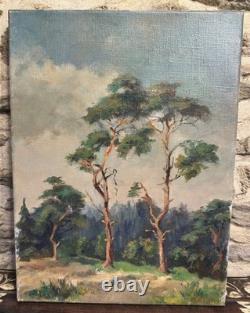
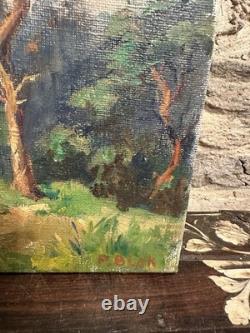
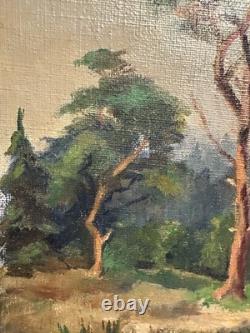
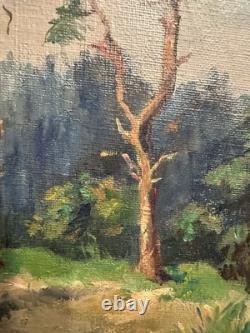
French School, 20th century, signed. Undergrowth with Scots Pines. Oil on canvas.



French School, 20th century
Woodland with Scots Pines.
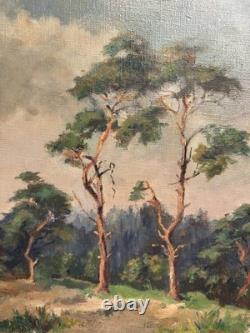
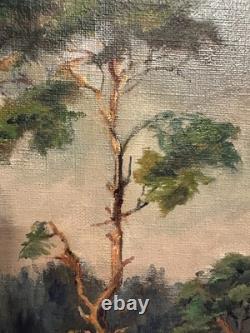
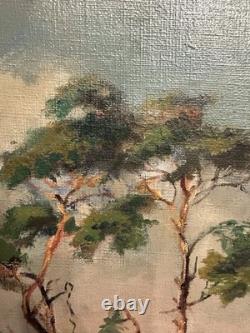
This oil painting depicts a classic subject of French woodland painting from the first half of the 20th century: two slender Scots pines, identifiable by their salmon-coloured bark, which turns orange towards the top of the trunk—a distinctive feature of this species among European conifers.
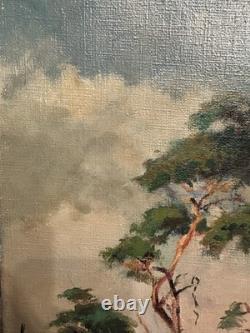
This painting belongs to that tradition: a dirt path, a grassy clearing and a wooded edge in the background, beneath a cloudy sky rendered in broad brushstrokes. The handling remains close to post-Impressionist naturalism.
The appeal of this oil painting lies in its faithful depiction of the Scots pine, a tree species less frequently represented in genre painting than its Mediterranean relatives, here rendered with particular attention to the colour of its bark.
The canvas is in good overall condition and mounted on a stretcher, with slight rubbing along the edges and wear consistent with its age. It retains a freshness of colour that brings out the appeal of this unusual woodland subject.
Geographical setting: Scots pine woodland, forest landscape—northern or central France, resembling the Oise, Sologne or Burgundy—France.
French School, 20th century
Woodland with Scots Pines.
This oil painting depicts a classic subject of French woodland painting from the early to mid-20th century: two slender Scots pines (Pinus sylvestris), identifiable by the salmon-orange bark on their upper trunks, a distinctive feature of this species among European conifers. Scots pine grows widely across the sandy, wooded regions of northern and central France—the Oise heathlands, the Forest of Fontainebleau, Sologne and the Burgundian plateaus—and has inspired a distinct woodland painting tradition, separate from that associated with the maritime and Aleppo pines of the Mediterranean coast.
This work belongs to that tradition: a dirt path, a grassy clearing and a wooded edge in the background, beneath a cloudy sky rendered in broad brushstrokes, in a style still close to post-Impressionist naturalism.
The painting’s appeal lies in its faithful rendering of the Scots pine, a tree species less often depicted in genre painting than its Mediterranean relatives, here portrayed with particular attention to the colour of its bark.
The canvas is in good overall condition and mounted on a stretcher, with light rubbing along the edges and wear consistent with its age. It retains a freshness of colour that enhances this unusual woodland subject.
French School, 20th century
Woodland Landscape with Scots Pines.
This oil painting depicts a classic subject of French woodland painting from the first half of the 20th century: two slender Scots pines (Pinus sylvestris), identifiable by the salmon-to-orange bark on their upper trunks, a distinctive feature of this species among European conifers. The Scots pine is widespread in the sandy, wooded regions of northern and central France—the Oise heathlands, the Forest of Fontainebleau, Sologne and the Burgundian plateaus—and has inspired its own woodland painting tradition, distinct from that associated with the maritime and Aleppo pines of the Mediterranean coast.
This work belongs to that tradition: a dirt path, a grassy clearing and a wooded edge in the background, beneath a cloudy sky painted in broad brushstrokes, in a style close to post-Impressionist naturalism.
Several painters of the 20th century.
The appeal of this painting lies in its faithful depiction of the Scots pine, a tree species less frequently represented in genre painting than its Mediterranean relatives.
The canvas is in good overall condition and mounted on a stretcher, with slight rubbing along the edges and age-related wear. Its fresh colours bring this unusual woodland subject to life.
French School, 20th century
Woodland with Scots Pines.
This oil painting depicts a classic subject of French woodland painting from the first half of the 20th century: two slender Scots pines (Pinus sylvestris), identifiable by the salmon-orange bark on their upper trunks, a distinctive feature of this species among European conifers.
The Scots pine is widespread in the sandy, wooded regions of northern and central France—the Oise heathlands, the Forest of Fontainebleau, Sologne and the Burgundian plateaus—and has inspired a woodland painting tradition distinct from that associated with the maritime and Aleppo pines of the Mediterranean coast.
This work belongs to that tradition: a dirt path, a grassy clearing and a wooded edge in the background, beneath a cloudy sky rendered in broad brushstrokes, in a style still close to post-Impressionist naturalism.
The appeal of this work lies in its faithful rendering of the Scots pine, a tree species less frequently depicted in genre painting than its Mediterranean relatives.
The canvas is in good overall condition and mounted on a stretcher, with slight wear along the edges consistent with its age. It retains a freshness of colour that enhances this unusual woodland subject.
French School, 20th century
Woodland with Scots Pines.
This oil painting depicts a classic subject of French woodland painting from the first half of the 20th century: two slender Scots pines (Pinus sylvestris), identifiable by the salmon-orange bark on their upper trunks, a distinctive feature of this species among European conifers. The Scots pine grows widely in the sandy, wooded regions of northern and central France—the Oise heathlands, the Forest of Fontainebleau, Sologne and the Burgundian plateaus—and has inspired a woodland painting tradition distinct from that associated with the maritime and Aleppo pines of the Mediterranean coast.
This work belongs to that tradition: a dirt path, a grassy clearing and a wooded edge in the background, beneath a cloudy sky rendered in broad brushstrokes, in a style still close to post-Impressionist naturalism.
The appeal of this work lies in its faithful depiction of the Scots pine, a species less frequently represented in genre painting than its Mediterranean relatives.
The canvas is in good overall condition and mounted on a stretcher, with slight wear along the edges consistent with its age. It retains a freshness of colour that enhances this unusual woodland subject.