
- Home
- Artist
- André Poirson (4)
- Anonymous (6)
- Bouquier (3)
- Claude Revardeau (2)
- Clery Pierpont (2)
- Contemporary (5)
- Courtine (2)
- Felicia Butel (2)
- Georges Guérin (2)
- Henri Royet (2)
- Illegible (2)
- Jean-paul Ulysse (18)
- Lucien Royer (3)
- Maurice Barle (3)
- Maurice Bismuth (2)
- Renoir (3)
- René Lévy (2)
- Siarnowski (3)
- Unknown (5)
- Unsigned (4)
- Other (5440)
- Characteristics
- Boxed (2)
- Framed (32)
- Framed, On Canvas (13)
- Framed, On Panel (3)
- Framed, On Wood (62)
- Framed, Signed (5)
- Miniature (3)
- On Canvas (16)
- On Panel (73)
- On Wood (183)
- On Wood, Framed (2)
- On Wood, On Canvas (9)
- On Wood, On Panel (21)
- On Wood, Paper (3)
- On Wood, Signed (4)
- One Of A Kind (ooak) (4)
- Signed (27)
- Signed, On Canvas (21)
- Signed, On Panel (12)
- Signed, On Wood (90)
- Other (4930)
- Features
- Material
- Style
- 1900 (13)
- 1920 (15)
- 1920-1930 (27)
- 1920-1940 (9)
- 20th Century Style (15)
- Art Deco (16)
- Contemporary (7)
- Impressionism (11)
- Non-spécifié (59)
- Not Specified (20)
- Unspecified (77)
- École De Barbizon (12)
- 1930 (18)
- 1930-1940 (18)
- 1940 (26)
- 1940-1960 (264)
- 1970 (48)
- 1980 (29)
- 1990 (14)
- 2003 (8)
- Other (4809)
- Type
- Acrylique (4)
- Christianisme (5)
- Composition Mixte (2)
- Folk Art Object (2)
- Gouache (3)
- Huile (3292)
- Huile Sur Bois (20)
- Huile Sur Bois. (3)
- Huile Sur Panneau (15)
- Huile Sur Toile (4)
- Icon (2)
- Mural (5)
- Oil (1702)
- Oil On Canvas (2)
- Oil On Panel (2)
- Oil On Wood (5)
- Painting (9)
- Peinture (11)
- Other (427)
DEZAUNAY Emile Alfred (1854-1938) Young Woman with a Hat Oil on Canvas
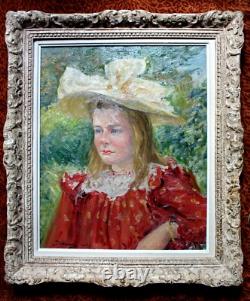
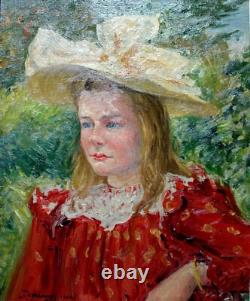
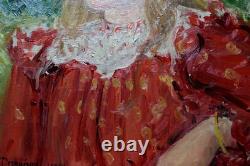
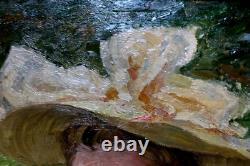
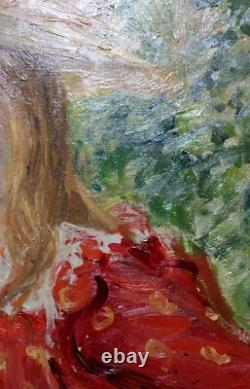
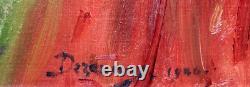
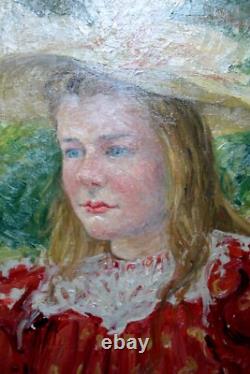
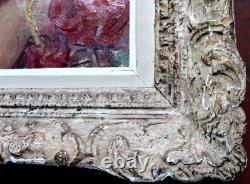
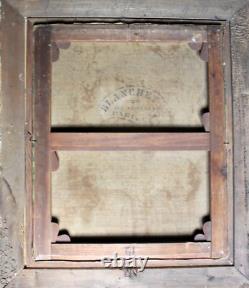

Description: Oil on canvas mounted on a wooden frame. In a beautiful Montparnasse frame, the work is highlighted with white wooden strips.
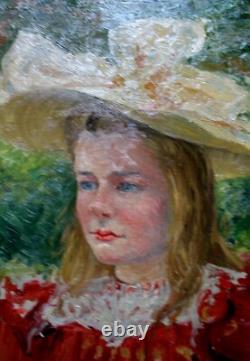
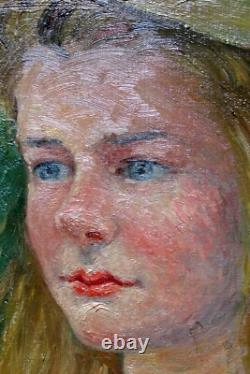
It depicts a young blonde woman wearing a lovely summer hat in the neo-impressionist style reminiscent of Pierre-Auguste Renoir's "Woman with a Flower Hat." The brushwork, with touches of green enhancing the portrait of this young Breton woman, magnifies the artwork. Signed and dated (1900) at the bottom left.Young woman with a hat. Artwork: 50 X 60 cm Frame: 80 X 68 cm. Émile Alfred Marie Dezaunay, born on February 25, 1854, in Nantes, where he died on June 4, 1938, was a French painter and engraver.
Dezaunay is a painter of the Pont-Aven school, originally from Nantes. It was Jules-Élie Delaunay who recommended him for admission to the École des beaux-arts in Paris, where he joined his studio in 1875. He was also a student of Pierre Puvis de Chavannes. He participated in the triennial exhibition of fine arts in Nantes in 1886, an exhibition to which established painters who had participated in the Paris Salon were invited.It was on this occasion that Émile Dezaunay met Maxime Maufra, and a great friendship was born between the two men. Maufra introduced him to Pont-Aven in 1890. He stayed at the Gloanec boarding house and met Gauguin, with whom he painted for two consecutive summers at Pouldu. From 1892, he socialized with Aristide Briand and the poet Victor-Émile Michelet in Maxime Maufra's Bateau-Lavoir studio in Montmartre. That same year, he exhibited at the second exhibition of impressionist and symbolist painters alongside Émile Bernard, Maurice Denis, Charles Filiger, Maxime Maufra, and Paul Sérusier.
Dezaunay never spoke of the education he received or the theories of light; for him, only the freedom of expression of the neo-impressionists mattered. A very personal technique with a broken brushstroke set him apart from his peers. He is present in numerous museums.Born at 3, rue Du Guesclin in Nantes, into a well-to-do merchant family, Émile Dezaunay became an orphan of his father in 1857. His mother, Caroline Tronson, a first cousin of Jules Verne, raised him alone, under the guardianship of the child's uncles.
The Nantes painter Jules-Élie Delaunay recommended him for admission to the École des beaux-arts in Paris, where he joined his studio in 1875. He married in Nantes in 1884 and participated in the triennial exhibition of fine arts in Nantes in 1886, an exhibition to which established painters who had participated in the Paris Salon were invited. On this occasion, Émile Dezaunay met Maxime Maufra, leading to a great friendship between the two men. Dezaunay frequented Eugène Delâtre's studio, where Maufra also created his first engravings in 1892, influenced by Paul Gauguin. He excelled in the art of watercolor and engraving. His career was particularly fruitful between 1892 and 1909. The critic Arsène Alexandre wrote: "His art is both popular and refined; it is mischievous when he looks, candid when he tells." Dezaunay exhibited and participated in all the Salons organized by the Société des arts de Nantes until 1914. That same year, he exhibited at the second exhibition of impressionist and symbolist painters.
He moved to Neuilly-sur-Seine in 1897 and exhibited at Moline, rue Laffitte, in Paris. He sold about a hundred of his works at the Drouot auction house on March 25, 1898.
A catalog prefaced by Arsène Alexandre was published for this occasion. In 1909, he returned to Nantes after the death of his eldest son. The couple led a reclusive life there, leaving their home only for a few short stays in Brittany and Vendée. He no longer exhibited except at the Salon d'automne, but participated in all the exhibitions organized by the Friends of Arts and Breton Artists until 1914. In 1913, he moved into a house on rue des Folies Chaillou in Nantes, built by Paul Devorsine, the architect and father-in-law of his daughter, who lived in the neighboring house.
He would now paint in the spacious and bright studio overlooking the large garden with its centennial cedar and flowering beds. His friend Maxime Maufra died on May 23, 1918. They had taken great hikes together through Brittany. He presented the paintings Port de Manech (marine) and Château de Clisson (Loire-Inférieure) at the Salon d'automne in 1928. Dezaunay became a widower in 1929.In 1934, the Mignon-Massart gallery dedicated an exhibition to him, presenting 42 paintings, many of which had previously been exhibited at the Salon d'automne. In February 1938, this same gallery held another exhibition of his works, which Dezaunay opened shortly before his death on June 4, 1938. At that time, his residence was established at 12, passage Saint-Yves in Nantes. He was buried three days later in the La Bouteillerie cemetery (section FF, row 9).
Works in public collections: Nantes, Museum of Fine Arts. The Poacher, before 1889, oil on canvas. Young Girl from Pont-L'Abbé; Study Head, before 1912, oil on canvas. The Port of Nantes, 1914, oil on canvas.
Little Girls with Chestnuts, 1899, oil on canvas. Portrait of a Little Boy, before 1912, oil on canvas. On the Beach, oil on canvas. Pont-Aven, Museum of Fine Arts.
Return from Fishing, around 1900, watercolor. Young Girl from Rosporden Sitting, around 1895, color aquatint. The Little Beggar from Pleyben, around 1895, color aquatint. The Aven at Moulin Neuf. Quimper, Departmental Museum of Brittany.
Collections of drawings and prints, including: Young Girl and Child from Rosporden, etching and color aquatint. Mystery of Saint Gwénolé, 1898, illustration for the cover of the play performed at the theater in Morlaix and on the main square of Ploujean on August 13 and 14, 1898. Saint-Nazaire, Museum of Fine Arts: Marine at Saint-Michel, 1913.