
- Home
- Art Movement
- Artist
- André Poirson (4)
- Anonymous (6)
- Bouquier (3)
- Claude Revardeau (2)
- Clery Pierpont (2)
- Contemporary (5)
- Courtine (2)
- Felicia Butel (2)
- Georges Guérin (2)
- Henri Royet (2)
- Illegible (2)
- Jean-paul Ulysse (18)
- Lucien Royer (3)
- Maurice Barle (3)
- Maurice Bismuth (2)
- Renoir (3)
- René Lévy (2)
- Siarnowski (3)
- Unknown (5)
- Unsigned (4)
- Other (5446)
- Features
- Genre
- Abstrait (59)
- Académisme (57)
- Art Deco (53)
- Art Déco (50)
- Barbizon (30)
- Baroque (91)
- Classicism (101)
- Classicisme (225)
- Expressionism (223)
- Expressionnisme (160)
- Fauvism (46)
- Fauvisme (53)
- Impressionism (243)
- Impressionnisme (497)
- Impressionniste (33)
- Orientalisme (74)
- Realism (74)
- Renaissance (29)
- Romantisme (116)
- Réalisme (204)
- Other (3103)
- Theme
- Abstract (8)
- Animals (32)
- Architecture (12)
- Character (92)
- Child (6)
- Figure (7)
- Flower, Tree (18)
- Flowers (3)
- Genre Scene (57)
- History, War (8)
- Horse Portrait. (2)
- Hunting, Fishing (8)
- Landscape (480)
- Marine (5)
- Nature, Landscapes (5)
- Portrait (16)
- Religion, Mythology (28)
- Seascape, Boat (82)
- Still Life (71)
- Windmills (2)
- Other (4579)
- Type
- Acrylique (4)
- Christianisme (5)
- Composition Mixte (2)
- Folk Art Object (2)
- Gouache (3)
- Huile (3292)
- Huile Sur Bois (20)
- Huile Sur Bois. (3)
- Huile Sur Panneau (15)
- Huile Sur Toile (4)
- Icon (2)
- Mural (5)
- Oil (1708)
- Oil On Canvas (2)
- Oil On Panel (2)
- Oil On Wood (5)
- Painting (9)
- Peinture (11)
- Other (427)
BELLONI Serge 1925–2005 Painter of Paris Oil on wood Present in museums
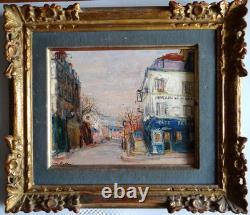
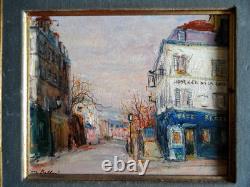



BELLONI Serge 1925 - 2005. 40.5 x 35.5. Carnavalet Museum in Paris, where several of these works are housed.
Ca' Pesaro Museum in Venice. Serge Belloni, known as the Painter of Paris, was the son of the upholsterer Luigi Belloni and Elvira Belloni, née Molinari. He arrived in Paris in 1933, where he studied painting at the École Supérieure des Beaux-Arts in Paris. He began exhibiting his paintings in 1946.First Prize for Painting in Versailles (1949), Marie Bashkirtseff Prize (1952), Silver Medal of the City of Paris, Vermeil Medal of the City of Paris (1980). Serge Belloni was born in Piacenza, Italy, on February 25, 1925; from childhood, he lived in Paris, in the Faubourg Saint-Antoine, where his parents had lived for many years. His father, an artisan, worked there as an upholsterer-decorator. Serge Belloni had to work part-time to pay for his studies at the École des Beaux-Arts; these were difficult years that left a lasting mark on him. At that time, he became friends with Lucien Moretti and Gérard Blondel.
Serge Belloni made a name for himself very young in exhibitions, following from the beginning a solitary path, far from artistic groups. He organized his first exhibition in Paris at the age of 21; from then on, he would live solely, and uncompromisingly, from his painting, carrying, as he liked to say, his cross every day. In any weather, he painted “from life.” Numerous trips to Holland allowed him to study on site the secrets of the Flemish masters. He worked on rediscovering old technical methods, which he would continue to refine. He used egg tempera technique.
Serge Belloni worked every day, in every season, without ever stopping, as if life were slipping away from him at every moment. His paintings are found in the most important collections: Paris, Milan, Moscow, New York. Serge Belloni died in Menton on October 28, 2005. General Inspector of the Museums of the City of Paris - Chief Curator of the Carnavalet Museum. At every period of its history, since the Renaissance, Paris has found painters capable of examining its permanent or fleeting face and passing it on to posterity. As can be seen at Carnavalet, the city of the 17th century lives for us thanks to Abraham de Verwer and other specialists in urban landscape whose names are unknown to us.The Paris of Louis XV and Louis XVI was faithfully represented by Grevenbroeck, Raguenet, P. De Machy, and Hubert Robert. In the Romantic era, the spectacle of the capital inspired Bouhot, Canella, and many minor masters, but also Corot and Georges Michel.
In the second half of the 19th century, Paris had certain Impressionists as interpreters, alongside Lépine, Jongkind, and observers such as Jean Béraud and Luigi Loir. More recently, the tradition was continued by Bonnard, Marquet, and Utrillo. It would be a shame if, today, the dictatorship of non-figurative art and the convenient use of photography - whatever the value of its contribution - were to discourage good painters from taking Paris as their model.
The Paris of the second half of the 20th century must also have its interpreters, for the face of the city remains an inexhaustible theme, open to many variations according to the personality of the artists. To the question, why still paint Paris? that some may ask, Serge Belloni’s work offers a courageous and convincing answer. Born in Italy, Serge Belloni likes to set up his easel along the canals and in front of the pink façades of Venice, whose timeless poetry he knows how to convey.
He also created a genre of his own: flower paintings on a gold background. But it is clearly from Paris, where he settled, that he draws his inspiration most willingly. While fitting without any shame into the centuries-old tradition of urban landscape painting, Serge Belloni rejuvenates it through the personal sensitivity of his gaze, an attentive gaze in which much love can be sensed. Many Parisian places have seen him at work. In Belleville and Montmartre, with their old walls and uneven streets, he captured the discreet and somewhat melancholy poetry.
The Porte Saint-Denis, the rose garden of Bagatelle, and a certain old bistro in the center are among the various subjects that aroused his curiosity. But he does not hide his preference for the landscape that has always made Paris famous: that of the Seine with its graceful curve, its islands and banks, its bridges and quays, and the monuments lining its course from Notre-Dame to the Eiffel Tower. This landscape, long cherished by painters, appears here again in all its breadth and grace, Serge Belloni having once more discovered the soul of the city in it. It happens that spring, summer, or autumn adorn the artist’s chosen subjects with their colors. But winter is, for Serge Belloni, the true season of Paris. Winter, because it strips the trees bare, reducing them to the fine network of their branches, and thus allows one to better grasp the subtle harmony of sky, water, and stone. Winter, because it gives light its most captivating variations and color its most precious nuances.For Serge Belloni, cold, clouds, rain, and snow are friends, and he attaches no gloomy intention to this affection. Winter gives him the opportunity to bring into play all the resources of his craft as a painter, a fine, solid, and thoughtful craft, in which no concession to the whims of fashion can be found. As much a sensitive as a faithful interpreter of the Parisian landscape, Serge Belloni has his rightful place in this museum devoted to Paris through the ages. He is present here in the temporary form of this exhibition, which he himself conceived, rightly, as a “tribute to Paris.” He will remain here permanently thanks to paintings now part of the museum’s collections: one first acquired by the City in 1963; another donated by Mr.
Jean Griot; and two given to the institution through the generosity of the artist himself. May I be allowed to thank Serge Belloni for this gift and for the help he kindly provided in bringing to fruition a project in keeping with Carnavalet’s Parisian vocation. Musée Carnavalet: Tribute to Paris, February 11 - April 13, 1986.