
- Home
- Art Movement
- Genre
- Abstrait (59)
- Académisme (57)
- Art Deco (52)
- Art Déco (50)
- Barbizon (30)
- Baroque (91)
- Classicism (101)
- Classicisme (225)
- Expressionism (222)
- Expressionnisme (160)
- Fauvism (46)
- Fauvisme (53)
- Impressionism (243)
- Impressionnisme (497)
- Impressionniste (33)
- Orientalisme (74)
- Realism (74)
- Renaissance (29)
- Romantisme (116)
- Réalisme (204)
- Other (3102)
- Height
- Style
- 1900 (13)
- 1920 (15)
- 1920-1930 (27)
- 1920-1940 (9)
- 20th Century Style (15)
- Art Deco (16)
- Contemporary (7)
- Impressionism (11)
- Non-spécifié (59)
- Not Specified (20)
- Unspecified (77)
- École De Barbizon (12)
- 1930 (18)
- 1930-1940 (18)
- 1940 (26)
- 1940-1960 (264)
- 1970 (48)
- 1980 (29)
- 1990 (14)
- 2003 (8)
- Other (4812)
- Theme
- Abstract (8)
- Animals (32)
- Architecture (12)
- Character (92)
- Child (6)
- Figure (7)
- Flower, Tree (18)
- Flowers (3)
- Genre Scene (57)
- History, War (8)
- Horse Portrait. (2)
- Hunting, Fishing (8)
- Landscape (480)
- Marine (5)
- Nature, Landscapes (5)
- Portrait (16)
- Religion, Mythology (28)
- Seascape, Boat (82)
- Still Life (71)
- Windmills (2)
- Other (4576)
- Type
- Acrylique (4)
- Christianisme (5)
- Composition Mixte (2)
- Folk Art Object (2)
- Gouache (3)
- Huile (3292)
- Huile Sur Bois (20)
- Huile Sur Bois. (3)
- Huile Sur Panneau (15)
- Huile Sur Toile (4)
- Icon (2)
- Mural (5)
- Oil (1705)
- Oil On Canvas (2)
- Oil On Panel (2)
- Oil On Wood (5)
- Painting (9)
- Peinture (11)
- Other (427)
Antique Oil Painting, Barbizon School, Welti, Swiss Alps, Mountain, 19th Century
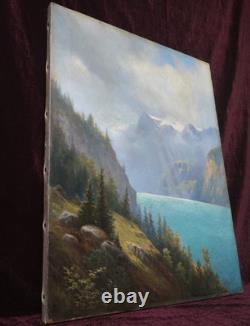
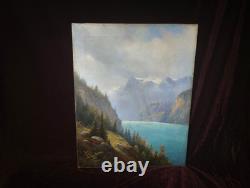
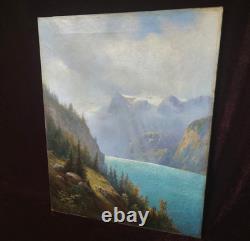
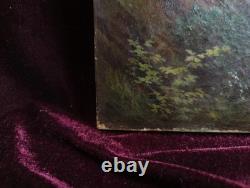
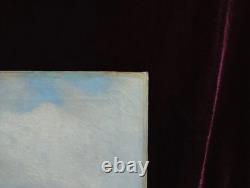
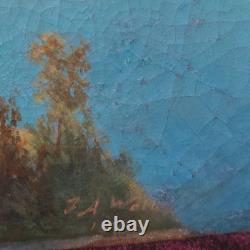
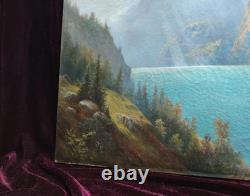
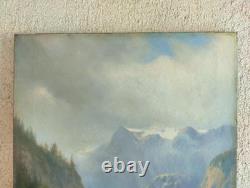
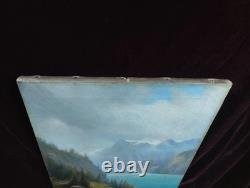
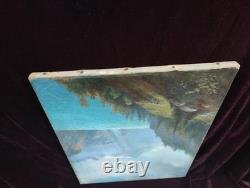
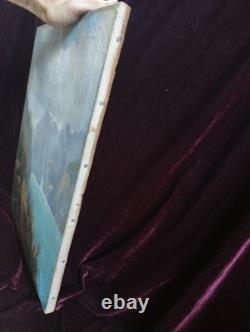
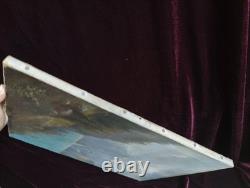
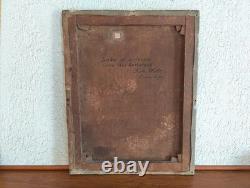
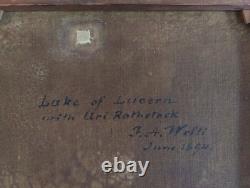
Hello, I am offering for sale this painting, which measures 50 cm high by 40 cm wide. It is a superb oil on canvas, signed lower right J. Welti and dated 1894, and countersigned on the back of the canvas with the inscription Lake of Lucern with Uri Rothstock J. Welti June 1894 (the words Rothstock and Lucern are spelled in an old-fashioned way, typical of the 19th century among others). The painter probably chose to include these two signatures to perpetuate a sense of prestige and family heritage, as was often done in bourgeois families or in families that had achieved, like the painter’s own family, remarkable financial success, just as giving one of one’s first names, or even the whole name, to one’s descendants was also common. An interesting biography of Welti is available on Wikipedia in 7 languages. My description, based on these 7 versions, brings together the essentials, rephrased, but it is still a good idea to consult them for additional details and/or further reading, as well as for an overview of his works. At the age of 20, in 1882, with his father’s approval, he decided to make painting his main means of expression by enrolling at the Academy of Fine Arts in Munich, under the guidance of Alexander Strähuber, Nikolaus Gysis and Ludwig von Löfftz. The latter recognized the talent of his new student in a letter he sent to his father.
It is interesting to note the career of his key mentor, who received an academic training before gradually moving toward Symbolism, of which he became one of the main representatives; Welti evolved in exactly the same direction. This was undoubtedly the result of his deep admiration for the man who helped him refine his skills and establish himself.
He is nevertheless distinguished by the strong fantastical dimension of his work, incorporating medieval influences, elements of legends and fairy tales, and nightmares (apparently his own dreams and nightmares were also precious sources of inspiration), which can be found from the second half of the 1890s onward. Welti’s talent earned him growing renown, notably with a painting exhibition in 1899 in the gallery of the influential art collector Friedrich Gurlitt, also known as Fritz Gurlitt, who died in 1893. It is interesting to note that he was a great supporter of Arnold Böcklin and was noticed even in the highest Swiss political circles, which notably purchased his painting The Artist’s Parents, superb portraits of his parents, and commissioned him, among his best-known projects, to create stained glass for the Bundeshaus, the Federal Palace in Bern, and an imposing mural, begun in late 1907, The Landsgemeinde, in cooperation with the painter Wilhelm Balmer, comprising more than 150 figures in a purely Swiss natural setting, depicting a political scene from the 18th century, and even postage stamps for the Swiss postal service. He died in 1912, at the age of 50, of unknown causes; all we know is that his wife passed away less than a year before him. He left one of his major works, The Landsgemeinde, unfinished, with 2 of the 5 images missing; his friend Wilhelm Balmer completed them and paid tribute to him by giving one of the figures his appearance.The Kunsthaus Zurich, the city’s museum of fine arts, is currently the main holder of Welti’s works. This is a remarkable testimony to the period when Welti was still painting under academic influence, and probably one of the last examples of this transitional period available today, since his adoption of Symbolism and fantasy came in 1896, the year of the first known works from his artistic turn. This composition already foreshadows the Symbolist desire to prioritize emotion and atmosphere over the strict pursuit of perfect rendering. One can sense the painter’s very strong attachment to his country in this typically Swiss landscape, in which his academic mastery is evident in every element of the composition: the clouds, with their volume, textures, and subtle tonal variations; the treatment of light, especially through the presence of these beams tearing through the misty veil to shine on the turquoise surface of the lake; the vegetation, combining harmonious colors, realistic appearance, and a considerable amount of detail; and the use of effects, culminating in the shimmering water made possible by a network of craquelure affecting only the surface of the lake, which alone explains why the painting must be admired from several meters away in order to appreciate its full essence.
That essence is a landscape of undeniable elegance, without a hint of bad taste; it is a painting that stands on its own; it is a work combining technical and artistic mastery with purity; it is restraint and precision; it is an obvious truth that lingers in the mind. Some craquelure here and there, all harmless, even in the water, which is a sign of an authentic painting.
A restoration in the sky, very well done. A few touch-ups in places.Those in the water, if you consider them noticeable from a reasonable viewing distance (they are more visible up close, but this painting is not meant to be viewed from close range), are more discreet than in the photos. The canvas tension is good, even very good. The photos were taken in natural light on a sunny afternoon, in a very well-lit room. The second and third photos are sufficiently faithful to the actual color rendering under these same conditions, even though reasonable differences may occur depending on your interior lighting and the display settings of the screen you use to view the listing.
Shipping will be handled with care, unless you prefer to collect it in person, which is entirely possible if you are able to travel. For this to be taken into account, it is imperative, if the carton is damaged, sufficiently so (it is up to you to determine this upon inspection) in any place whatsoever, and/or opened, even partially, that you ask the delivery person to note reservations, if it is a shipment by post, or that you refuse the parcel at the relay point staff, if it is a relay-point shipment, UNLESS, and you will need to ask them, you are able to enter reservations using the barcode scanner terminal for shipping labels — in which case you can then accept the parcel — before they scan the shipping label or perform any other operation confirming that you have collected the parcel; in other words, ask them to carefully check the condition of the carton, without omitting any area, in both cases before they take any action.
In the case of relay-point delivery, if you refuse receipt, the parcel will be kept by the relay point to be returned to the inspection service, in order to verify the carrier’s responsibility and make the insurance effective (information gathered from their website) if the item is damaged. In the case of the postal service, if delivery is made to your mailbox because the parcel size allows it, without hand delivery, and the carton is sufficiently damaged (the extent of which it is up to you to determine), you must take it to the nearest post office unopened and ask the counter staff to return the parcel to me (information gathered from their website), again in anticipation of a delivery-service review, UNLESS, as in the case of relay-point delivery, the post office staff can note reservations. In all cases, do not hesitate to take photos of the damaged and/or opened carton.
You may think, for any reason, that the item inside the carton remains in perfect condition despite the parcel being sufficiently damaged (again, it is up to you to determine this upon inspection) and/or opened, even partially, and therefore that you do not need to make reservations, or that you should accept the parcel if reservations cannot be made; but be aware that this is like playing Russian roulette, since delivery services rely on the possibility of error, which, incidentally, suits them very well because, I repeat, the insurance is then no longer effective due to damage, because of the sacred transfer of responsibility from the carrier to the sender or recipient; less expense for them, then, since they will not have to pay the insurance amount! And do not rely on “shaking” the parcel to determine whether the item is broken; unless it is glass or ceramic, the sound of breakage is imperceptible, or it may simply be a protective element inside the parcel. Make sure to communicate all of this if someone else is collecting the parcel on your behalf. If, however, the condition of the returned item differs from its condition when I sent it, but there is no proof that the carriers are responsible, then there will be no refund, because even with excellent packaging, it can happen not only that shocks during transport are extremely severe, but also that this happens without any external damage, meaning to the carton. These are things that might not have happened during the initial shipment, and that might have been avoided if the buyer had collected the parcel and thus prevented a second transport, theoretically involving twice the risk for the item.
If you have any questions or would like more photos, please do not hesitate to let me know.
PS: I have other paintings on my profile.