
- Home
- Artist
- André Poirson (4)
- Anonymous (6)
- Bouquier (3)
- Claude Revardeau (2)
- Clery Pierpont (2)
- Contemporary (5)
- Courtine (2)
- Felicia Butel (2)
- Henri Royet (2)
- Illegible (2)
- Jean-paul Ulysse (18)
- Lery (2)
- Lucien Royer (3)
- Maurice Barle (3)
- Pierre Jaillet (2)
- Renoir (3)
- Siarnowski (3)
- Unknown (4)
- Unsigned (4)
- Werner Gilles (2)
- Other (5418)
- Characteristics
- Boxed (2)
- Framed (32)
- Framed, On Canvas (13)
- Framed, On Panel (3)
- Framed, On Wood (61)
- Framed, Signed (4)
- Miniature (3)
- On Canvas (15)
- On Panel (71)
- On Wood (180)
- On Wood, Framed (2)
- On Wood, On Canvas (9)
- On Wood, On Panel (21)
- On Wood, Paper (3)
- On Wood, Signed (4)
- One Of A Kind (ooak) (4)
- Signed (27)
- Signed, On Canvas (21)
- Signed, On Panel (12)
- Signed, On Wood (88)
- Other (4917)
- Genre
- Abstrait (59)
- Académisme (57)
- Art Deco (52)
- Art Déco (50)
- Barbizon (30)
- Baroque (91)
- Classicism (100)
- Classicisme (225)
- Expressionism (219)
- Expressionnisme (160)
- Fauvism (46)
- Fauvisme (53)
- Impressionism (240)
- Impressionnisme (497)
- Impressionniste (33)
- Orientalisme (74)
- Realism (73)
- Renaissance (29)
- Romantisme (116)
- Réalisme (204)
- Other (3084)
- Style
- 1900 (13)
- 1920 (15)
- 1920-1930 (27)
- 1920-1940 (9)
- 1930 (18)
- 1930-1940 (18)
- 1940-1960 (261)
- 20th Century Style (15)
- Art Deco (15)
- Contemporary (7)
- Impressionism (10)
- Non-spécifié (59)
- Not Specified (20)
- Unspecified (76)
- École De Barbizon (12)
- 1940 (26)
- 1970 (48)
- 1980 (29)
- 1990 (14)
- 2003 (8)
- Other (4792)
- Theme
- Abstract (8)
- Animals (31)
- Architecture (12)
- Character (92)
- Child (6)
- Figure (5)
- Flower, Tree (18)
- Flowers (3)
- Genre Scene (56)
- History, War (8)
- Hunting, Fishing (8)
- Landscape (471)
- Landscapes (2)
- Marine (5)
- Nature, Landscapes (4)
- Nude (2)
- Portrait (16)
- Religion, Mythology (28)
- Seascape, Boat (82)
- Still Life (69)
- Other (4566)
- Type
- Acrylique (4)
- Christianisme (5)
- Composition Mixte (2)
- Folk Art Object (2)
- Gouache (3)
- Huile (3292)
- Huile Sur Bois (20)
- Huile Sur Bois. (3)
- Huile Sur Panneau (15)
- Huile Sur Toile (4)
- Icon (2)
- Mural (5)
- Oil (1681)
- Oil On Canvas (2)
- Oil On Panel (2)
- Oil On Wood (5)
- Painting (9)
- Peinture (11)
- Other (425)
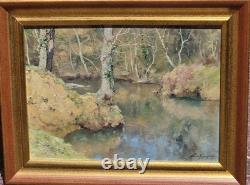
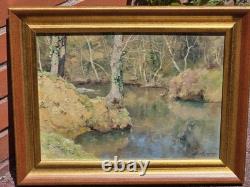
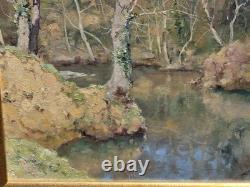
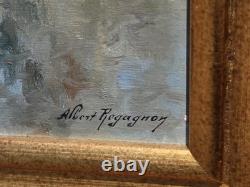
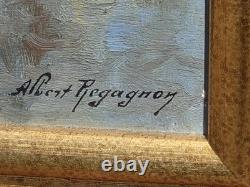
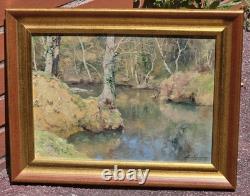
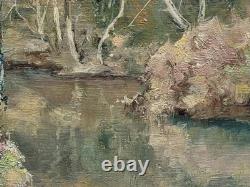
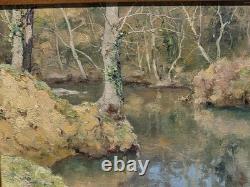
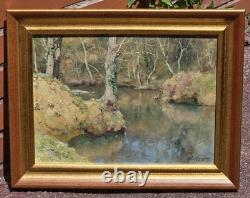
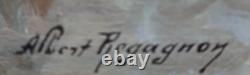
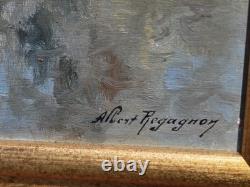
ALBERT REGAGNON. Titled “Lorp à Sentaraille.” Signed oil painting on wood panel.
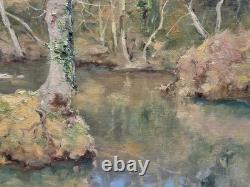


Albert Regagnon was born in Saint-Girons on January 8, 1874. A native of Ariège, he became a Toulousain at heart while still very young and has remained one ever since. He came from a middle-class family whose well-established, highly reputable trading business, then two generations old, provided a comfortable income. He enjoyed an easy and pleasant childhood.
His parents were kind and welcoming, offering generous hospitality and warmly receiving relatives and friends.
These guests came from many different backgrounds: painters, musicians, merchants, travelers, and officers returning from distant campaigns. They brought varied interests and stimulating conversations into the home. At the table, in the sitting room, or out on walks, the children learned more enjoyably than they did from their schoolbooks, gradually developing a taste for travel, singing, and painting.
Young Albert was particularly drawn to the company of his maternal uncle.
He loved his uncle’s cheerful kindness, good humor, and playful, teasing manner. He gladly accompanied him on visits to the Toulouse museum, where his uncle sometimes copied paintings by the masters. The young man’s artistic calling grew stronger every day. He happily spent his free afternoons shut away in his room, drawing and painting watercolors.
At the secondary school in Saint-Girons, where he studied, he invariably won first prize in drawing.
At fourteen, he was allowed to take lessons in the Toulouse studio of a decorative painter, Mr. Serres, who taught a few pupils.
But this lasted only a year and constituted his entire formal training, as his father was eager to put both his sons to work in the family business. Albert protested timidly: his vocation was genuine, and commerce held little appeal for him. He would have liked to enter the School of Fine Arts and pursue an artistic career, but his father did not believe painting could provide a family with a comfortable and respectable living. The young man yielded and could paint only in his rare moments of leisure.
Nevertheless, at fifteen, he exhibited a landscape at the Union Artistique in Toulouse. Encouraged by relatives and friends, he continued working on his own, with nature as his only teacher.
At nineteen, he enlisted in an artillery regiment and came to Toulouse, where he did more painting than military drills or routine duties. Several officers noticed his budding talent and commissioned works from him, one requesting a landscape, another a portrait. These were three happy years during which he devoted himself to his favorite art and finally led a life suited to his tastes and abilities.
On returning home, he resumed his place in the shop without enthusiasm, but determined to carry out his work conscientiously until retirement. A few years later, he married a modest, gentle, kind woman from Toulouse who suffered from poor health. The loss of their infant child, only a few months old, brought sorrow to the young household. Then, in 1914, he left for the war.
During the four years he spent in the Vosges, he found ways to paint in his moments of rest. Bombardments often forced him to close his little paint box.
Sometimes, after a shell had exploded nearby, he would remain where he was and finish his sketch, saying, “There, it’s over now!”
THE GARONNE AT BLAGNAC
He was thus able to bring home several lovely woodland scenes from the Vosges, views along the banks of the Meuse and the Meurthe, and an entire album of small watercolors. He treasures all these works in his studio as reminders of a past already distant.
A few years after his return from the war, his wife’s death grieved him deeply and left him sad and lost for many months. As Saint-Girons brought back too many painful memories, he left the business to his brother and settled permanently in Toulouse to devote himself entirely to painting. His lifelong dream was finally fulfilled.
It was then, around 1923, that the most productive period of his artistic life began.
Having established a new home, he has since led a happy life with a wife who occasionally offers sound advice but, above all, looks after his health and peace of mind, sparing him practical worries and concerns as much as possible.
There, in his modest studio on Avenue Maignan, his relatives and friends find him at work before his easel and canvases. He always welcomes them with his kindly smile, and their presence makes him pause for a few beneficial moments of rest.
For he works passionately, almost feverishly. Whenever the weather permits, even in the depths of winter, he roams the countryside in search of a beautiful spot.
Although he has painted some portraits and occasional still lifes, Albert Regagnon is primarily a landscape painter. He adores nature; it is nature that has taught him. He knows how to see and select the beauties it offers so generously.
He has traveled through most regions of France, but the French Riviera, the Pyrenees, the surroundings of Saint-Girons, Toulouse, and its outskirts are his main sources of inspiration. What attracts him is not sweeping vistas or vast panoramas, but rather a shady corner with a path disappearing beneath beautiful trees, a small waterfall, an old bridge, a ruined mill, medieval ruins, or a picturesque rock against which the water breaks in foaming eddies.
Sometimes, too, he paints a rural scene: threshing, harvesting, or a young couple chatting beside a resting team of horses.
Albert Regagnon exhibits with distinction every year at the Salon des Artistes Méridionaux, where he has shown his work since 1906.
La Revue Moderne des Arts, September:
“I had previously known nothing of this painter, and I was immediately won over by the directness and spontaneity of his brushwork, the clarity of his vision, and his freedom from any preconceived approach, other than the desire to convey nature in the full reality of its forms and colors—a reality from which he knows how to draw out all its exquisite poetry.
“He does not see nature through memories of art schools or museums. He has a gift for freshness and clarity, and in his work, sensitivity takes precedence over technical knowledge.”
Le Midi, June 18, 1942:
“Albert Regagnon is also a virtuoso.
His spring and autumn landscapes of Ariège and the Hautes-Pyrénées bring us face to face with the reality of mountain scenery, without sentimentality. With consummate skill in perspective and an admirable rendering of fleeting effects, he maintains an overall restraint that evokes a fresh atmosphere and makes one long for a restful holiday beside clear streams.”
La Dépêche, March 20, 1931:
“The outstanding quality of this artist, who paints outdoors with such mastery, appears to be his luminosity.
His palette dispenses sunlight lavishly, and even his woodland scenes reflect the same love of sumptuous illumination and rich light. Whether one looks at The Path at La Morère, in Santaraille, A Corner of Banyuls-sur-Mer, or The Pergola on the French Riviera or at Latou, one admires the same richness of color. The wonderfully true, translucent tones of the skies, the sea, and the streams, whether foaming or gently flowing, blend pleasingly with the intense greens of meadows and tall woodlands.”
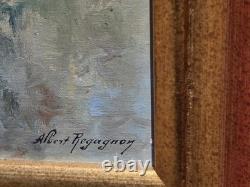
Painting signed at the lower right: Albert REGAGNON.”
Medium: Oil on wood panel.
Original work offered for sale by the artist.
Painting dimensions: 22 cm high × 31 cm wide.
Wooden frame dimensions: 31 cm high × 40 cm wide × 2.5 cm deep.
An additional charge applies to shipping to the rest of the world. For more information about shipping rates, please visit our website or contact us directly.